65 Years of Service
Reflections from Scott McCue & Stepanie Pace Marshall
Reflections
In the following narratives and insights, two long-standing board members who retired from the Fry Foundation’s board this year, Howard “Scott” McCue and Stephanie Pace Marshall, look back on how they came to the Foundation, recall their most compelling memories, and summarize what a lifetime of service has taught them.
We thank Scott for 37 years of board service, including 18 years as chair, and Stephanie for 28 years of service as a director and the first woman to serve on the Fry Foundation’s board. And we’re grateful to share their stories as told to us in their own words.
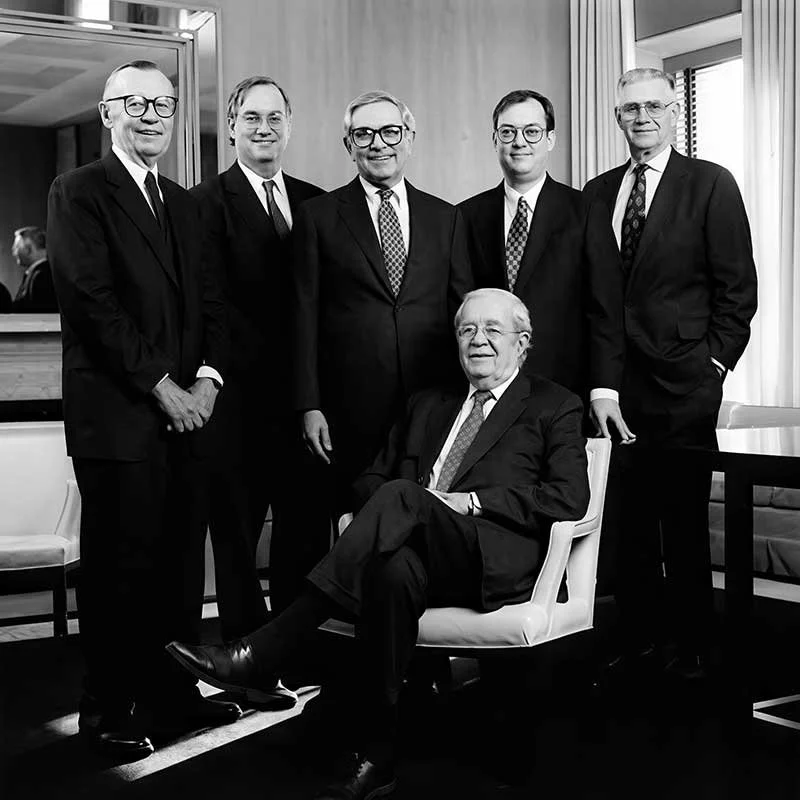
Board of Directors, 1992. From left, Roger Anderson, Howard M. “Scott” McCue III, Ben Rothblatt, Lloyd A. “Chip” Fry III, James Tremondt, and Edmund Stephan.
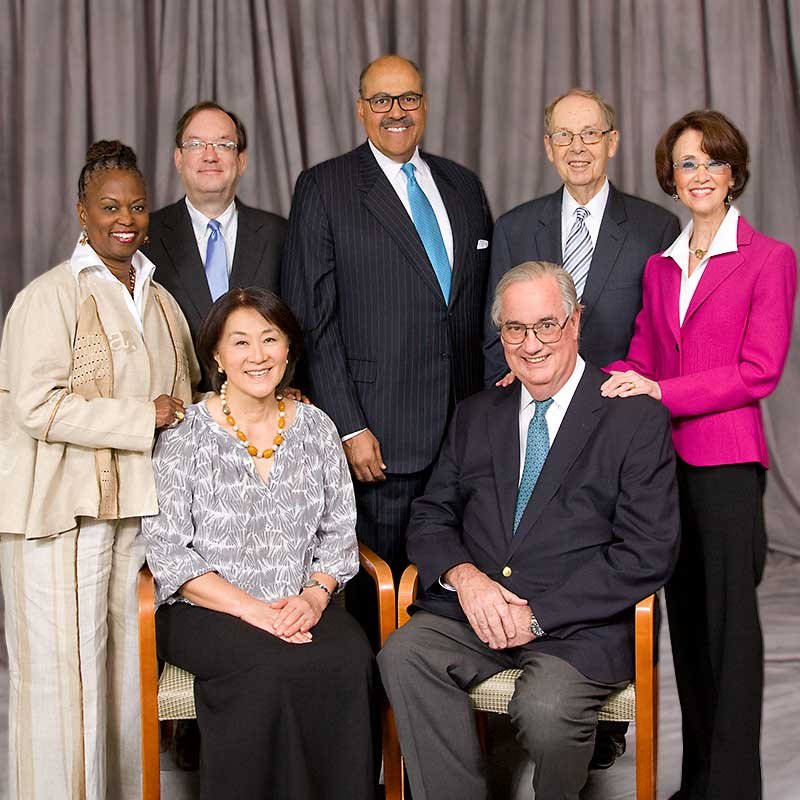
Board of Directors, 2016. From left, Amina Dickerson, Lloyd A. “Chip” Fry III, Graham C. Grady, David A. Donovan, Stephanie Pace Marshall, Unmi Song, and Howard M. “Scott” McCue III.
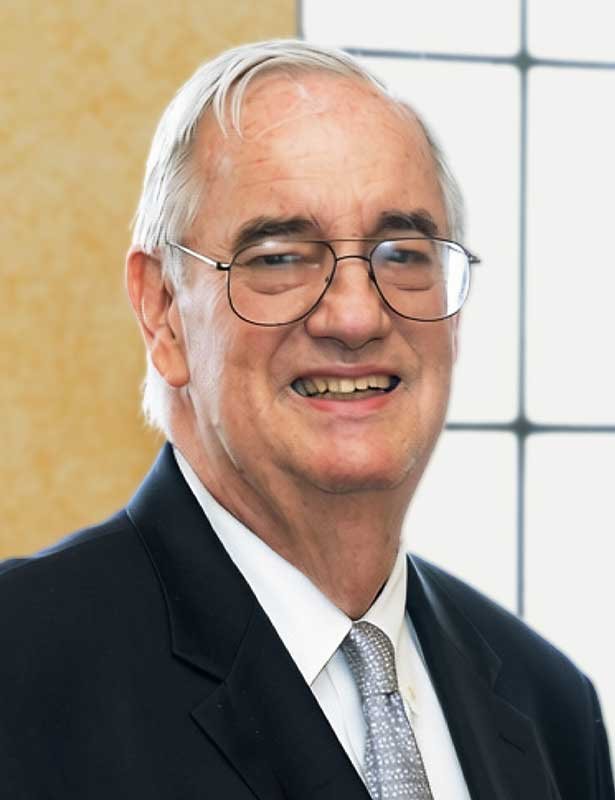
Howard M. “Scott” McCue III
How Scott met Lloyd A. Fry Sr. and later joined the board
One of the finest days in my professional career was the day in 1979 when Edmund Stephan, a senior partner at the law firm Mayer, Brown & Platt, walked into my office there and said, “Lloyd Fry Sr. is looking for a new counsel, and I want you to be on the team.”
At the time, Lloyd Fry Sr. was the sole director of essentially a checkbook foundation, but he was intrigued by the prospect of a private foundation that would leave a lasting impression on the City of Chicago. So, we wrote his estate plan with that in mind. When he died in 1981, I became the lawyer for his estate and trust. And then I became the secretary of the Fry Foundation before joining the board in 1989.
Considering the Foundation’s evolution and impact
The needs of Chicago have not changed all that dramatically since Lloyd Fry Sr.’s death. There are still a lot of people that need help with education, healthcare, social services, and employment. But the Foundation has become wiser and more focused. An important thing for board directors to recognize about a foundation of our size is that the ability to move the needle on the status of people in Chicago is limited. Therefore, one of the virtues of a good foundation director is humility—recognizing what you can and cannot do, and focusing on what you can do.
The Fry Foundation has done a good job of that. We have improved the status of Chicago’s public education, employment, health, and arts learning. Arts learning, in particular, is very dear to me.
How Scott developed his interest in arts learning
I grew up outside of Richmond, Virginia, and from there went to Princeton, which polite Southern boys did in those days, and then Harvard Law School. In law school, I met a student from Philadelphia, and she and I are still married. We’re in our 55th year. She has been my rock forever. Everybody at the Foundation knows Judy.
Judy and I have always loved classical music. When we were law students more than 50 years ago and didn’t have any money, we would go to rehearsals of the Boston Symphony because they were free. And I’ve always been interested in visual arts. When I was practicing law, many of my clients were interested and involved in the arts. We’ve enjoyed the City of Chicago. There is a lot of good art, music, dance, and theater here.
Recalling pivotal moments in the Foundation’s history
During the time I was chair of the Foundation’s board, the best thing we did was hire Unmi Song as president. She brought a very active intellect, and she brought focus. She urged us to be supportive of the grantee organizations by being there for them and by being predictable. Before Unmi, our program officers tended to be generalists, and they were good, smart people. But Unmi convinced us that the program officers should be experts in their program areas. We ended up with smart people that were also thought leaders in their areas.
And one of the most memorable things Unmi did was to bring on Sherly Chavarria, who is one of the truly inspiring thought leaders in the city. She’s an extraordinarily thoughtful person and another big thinker.
Considering what makes a good board and board member
The first characteristic is commitment: Board members have to read the grantees’ proposals and study whatever they need to study. A board needs a mixture of people that have big-picture, 30,000-foot views and people that focus on the little picture, on how particular grantees are doing. And I believe in diversity, and diversity of perspective. I hope that the Foundation will continue to have a diverse board with people that are passionate about helping the City of Chicago. The hardest thing we do is saying no. But sometimes you’ve got to say no because you can’t do everything. Sometimes we have to say no because we’re making priority judgments. None of those decisions are easy. But if you are clear and predictable and you articulate your standards, people understand.
There were also times when the board had discussions and disagreements on whether to fund an area more widely or more deeply. But that’s part of what’s enjoyable about being on a good board. We have good conversations.
The satisfaction of serving on the Foundation board for 37 years
Serving on the Fry Foundation’s board has been a great delight, and it has made my life more interesting. I’ve learned a lot about the City of Chicago and Cook County, and I’ve been able to scratch an itch that hasn’t gone away. I’m 80 years old now, but I still enjoy the opportunity to do something that feels good.
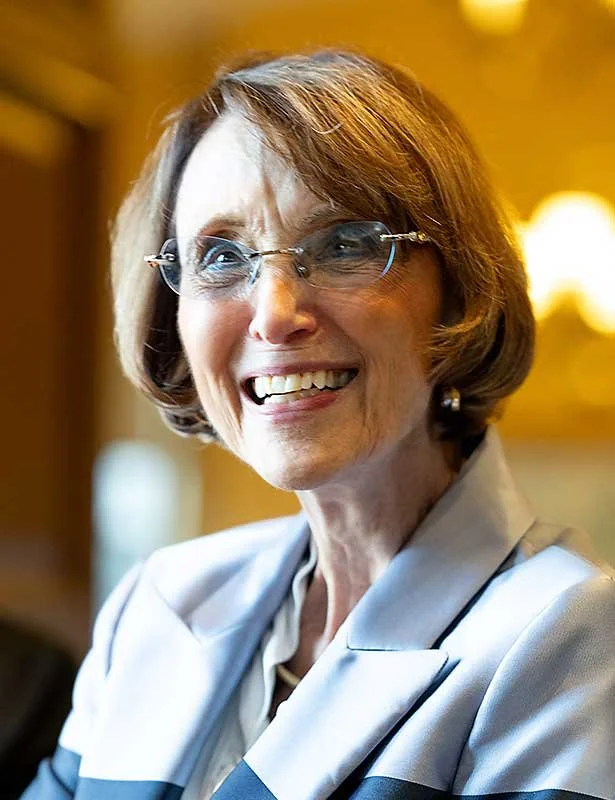
Stephanie Pace Marshall
Why Stephanie joined the Fry Foundation’s board
What first drew me to the Fry Foundation was its reputation, commitment, principles, and values that it not just verbalized but manifested. The Fry Foundation board and staff were very authentic, thoughtful, and strategic. And they valued what was really important to me, and that was partnership, as well as fidelity to the mission: The Fry Foundation is here to advance the human condition and help make life better for everyone. I felt the Foundation took on hard challenges and was not looking for easy answers; it really wanted to solve problems.
There are so many people that don’t think they belong, and that’s what the Fry Foundation is trying to tell them: “You belong.” With our support, advocacy, and partnership, the Fry Foundation says, “Yes, you do belong in healthcare, the arts, employment, and education.”
How Stephanie’s education background informed her work on the board
When I began as a student teacher, my mother was a teacher of children with autism and schizophrenia. I observed her teach, and I was dazzled by what I saw. She brought these children to life. I said to myself then, “I want to bring children alive just like my mother does.” I became a teacher and then a school leader, to touch more people. I always asked, “What is possible now, and what will it take?” I founded the Illinois Mathematics and Science Academy, which still is going strong.
My work has been about the conditions I can help create to make it more likely that human thriving will be the end product for everyone. And that’s the commitment of the Fry Foundation: It helps create conditions that make it more likely that human thriving will emerge. My work was about the transformation of learning and schooling, and I felt the Fry Foundation also embraced the construct of transformation: How do we change the story?
Becoming a true partner for grantees and the philanthropic community
The Fry Foundation has held its grantees to very high standards, but we didn’t tell them, “Here’s the standard, and you’re several notches below that.” We said, “Here’s the standard and here’s why, and we will walk side by side with you and provide not only financial resources but our partnership to help you meet those expectations and advance the human condition.” To do this hard work for the long haul takes a strong commitment to the partners you serve. We don’t walk away after the check is written.
Fry became a very trusted partner and resource not only to grantees but also to other organizations in the community. It did not surprise me when I heard people say, “Let’s find out what the Fry Foundation is doing and why it’s supporting something.”
Learning from the Foundation’s grantees
Our board listens to our grantees and visits them to see the work they do. I was always impressed whenever we would do site visits. The organizations were very well prepared and eager to respond to all of our queries. Their seriousness and commitment were palpable. I was impressed by not just the homework that they did but the hearts that they brought.
And that’s another thing the Fry Foundation does—it brings enormous heart to what we do.
Making difficult choices with finite resources
The Fry Foundation has a certain amount of money; it’s not bottomless. And so we made decisions all the time where we saw the needs far exceeded our capacity to address them. Those decisions are always tough because people come to us with documented needs. We have an enormously cohesive, collegial, and thoughtful board. We trust each other. We like each other very much. We work really well together. But we’re not easy on the Foundation or on ourselves because there’s no one that comes to us that is not in need.
We challenge one another and our own organization. The board is committed to total truth-telling, and we dig deeply along with our staff. If there’s something we don’t understand, we listen to and work with our program directors. We want to make sure that, when the Fry Foundation walks in the door, integrity, authenticity, commitment, and partnership walk in, too.
Offering advice for future board members
Never forget that it’s not about you. When you look in the mirror, see your partners. See those people that need your support and your voice and need you to walk beside them. The board has a fiduciary responsibility. It’s not our money. The Fry family has given their money and wants it to serve in the most beneficial way the largest number of people possible. And that’s your job—to make sure that whatever you’re doing with that money honors the Foundation’s integrity and values. You are the one that now has to make sure the money goes where it needs to go.